

🚨 The Case
🕒 It’s 3 pm in the Paediatric ED. 🏥
A mother 👩 rushes in with her 2-year-old boy. 👦
👵 Grandma found him sucking on a pink ball 🩷⚪ from the wardrobe drawer. 🗄️ Part of it is missing. 😬
▪️ 😊 He’s alert, playful and has vomited once 🤮 ▪️ ✅ Vitals are normal for age ▪️ 🛍️ Mum brought the rest of the ball in a plastic bag ▪️ 👃 It smells “like a cupboard” ▪️ 📦❌ No packaging. No brand name.
Your MO calls: “Boss, naphthalene ingestion. Can I send bloods and admit for observation?” 🧪
You pause. 🤔
Because you know something your MO doesn’t: not all mothballs are naphthalene. 💡🔍
And the difference between the three possible culprits is the difference between a seizure in the next hour, a haemolytic crisis in two days or a child who can go home tonight.
Let’s spoon-feed this one. 🥄
🧠 The MO’s Reflex (And Why It’s Wrong)
“Mothball = naphthalene” is a mental shortcut most of us learned somewhere in housemanship. It’s half true at best.
Mothballs are made from one of three compounds: camphor, naphthalene or paradichlorobenzene (PDB). Without the packaging they look the same, they smell broadly similar and they come in the same shapes. 👀
The Royal Children’s Hospital Melbourne puts it bluntly in their poisoning guideline: one naphthalene mothball is a high-risk, low-dose ingestion, but most mothballs aren’t naphthalene. 🎯
So the real question is not “how do we manage naphthalene?”
The real question is:
🔎 “Which ball is it?”
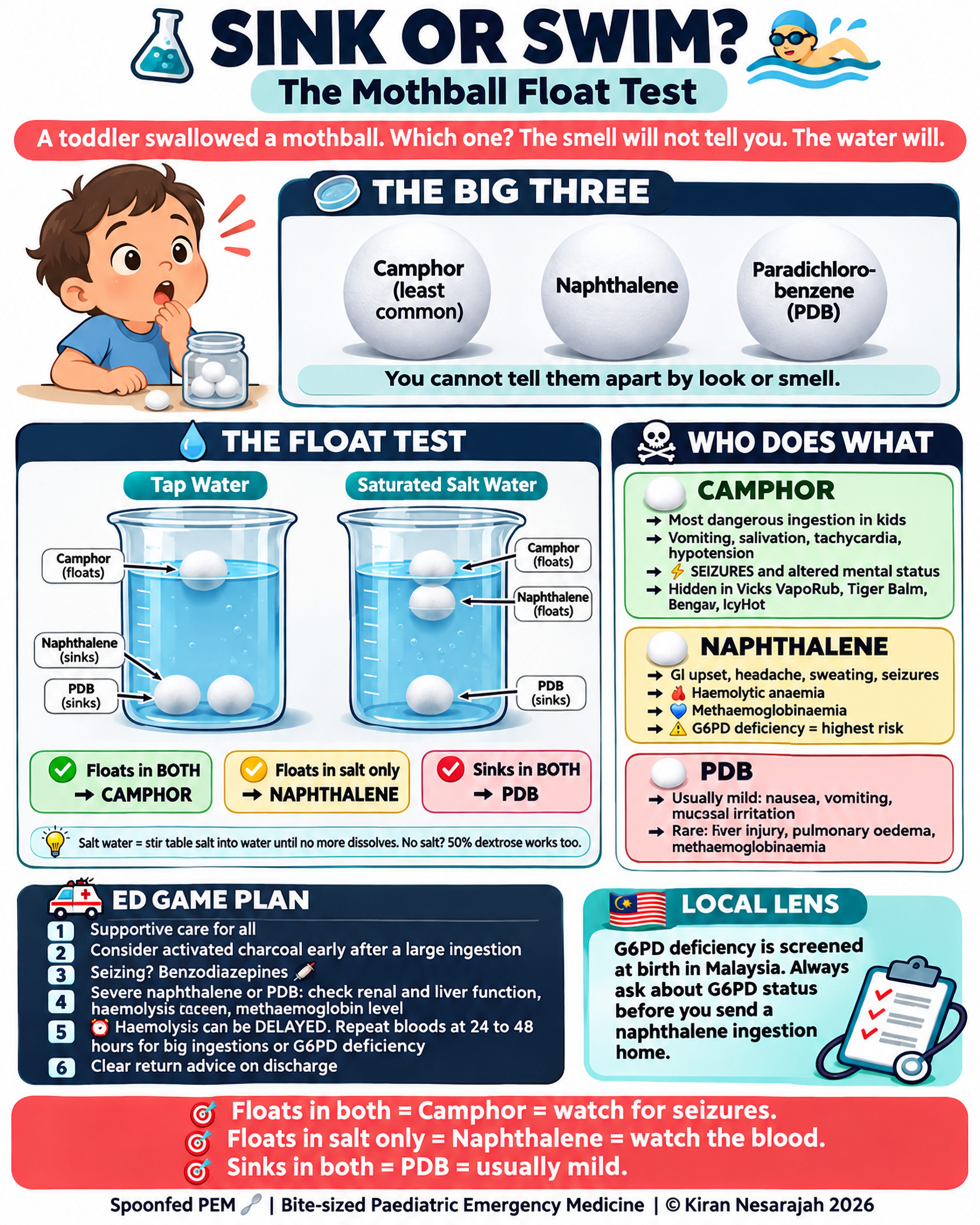
⚪ Meet the Big Three
🟢 CAMPHOR ➜ The original mothball compound (now least common in moth repellents) ➜ Specific gravity ≈ 0.99(lighter than water) ➜ Toxicity: CNS. Fast. Seizures. ➜ Danger window: minutes to ~90 minutes ➜ Also hiding in: Vicks VapoRub, balms, camphor blocks used for prayer and in the home
🟡 NAPHTHALENE ➜ The “classic” mothball ➜ Specific gravity ≈ 1.10 to 1.15 ➜ Toxicity: Blood. Delayed. Haemolysis and methaemoglobinaemia. ➜ Danger window: 24 to 48 hours and beyond ➜ Highest-risk group: G6PD deficiency 🩸
🔴 PARADICHLOROBENZENE (PDB) ➜ The modern replacement; also used in toilet and urinal deodoriser balls➜ Specific gravity ≈ 1.43 (heaviest of the three) ➜ Toxicity: relatively benign; usually GI upset and mucosal irritation ➜ Danger window: low risk for a small exploratory ingestion
💎 PEARL: Three balls. Three different organs. Three different clocks. ⏱️ Camphor hits the brain fast. Naphthalene hits the blood late. PDB mostly hits the stomach.
🩷 “But It’s PINK, Boss!”
Colour tells you nothing. ❌
Both naphthalene and PDB are sold as coloured balls across Southeast Asia. Marketplace listings in Indonesia show the same brand selling a coloured naphthalene ball and a coloured PDB toilet ball side by side. Pink, blue, green, yellow: these are dyes, not diagnoses. 🎨
Smell is no better. 👃 “Like a cupboard” describes all three to most parents.
And the name on the street won’t save you either. 🇲🇾 In Malay, kapur barus literally means “chalk of Barus” and originally referred to camphor. Today the same phrase is used for naphthalene and other mothballs too. So when a grandmother says “dia makan kapur barus”, she could mean any of the three. 🤷♀️
⚠️ TRAP: A coloured ball found in a wardrobe drawer may actually be a toilet deodoriser ball that someone repurposed. Many of those are PDB. Many are not. Test, don’t guess.
💧 The Float Test: Archimedes in the ED 🛁
This is where it gets fun. 🎉
Each compound has a different specific gravity (SG). Water has an SG of 1.00. A fully saturated salt solution has an SG of about 1.197. Line them up:
🪶 Camphor (0.99) ➜ lighter than water ➜ floats in tap water ⚖️ Naphthalene (~1.10) ➜ heavier than water, lighter than salt water ➜ sinks in tap water, floats in salt water 🪨 PDB (~1.43) ➜ heavier than both ➜ sinks in both
A Japanese study measured 450 PDB mothballs from 5 manufacturers (mean SG 1.429 to 1.437) and 150 naphthalene mothballs from 2 manufacturers (mean SG 1.094 to 1.100). The gap between them and saturated salt (1.197) is wide enough to separate them cleanly. 📏
🧂 How to Do It (2 minutes, zero budget)
STEP 1 ➜ Tap water 🚰 Drop the ball (or the biggest remaining fragment) into a cup of tap water. ▪️ Floats ➜ think CAMPHOR 🟢 ▪️ Sinks ➜ go to Step 2
STEP 2 ➜ Saturated salt water 🧂 Stir table salt into warm water until no more dissolves (you’ll see salt at the bottom). Let it settle. Drop the ball in. ▪️ Floats ➜ think NAPHTHALENE 🟡 ▪️ Sinks ➜ think PDB 🔴
💉 No Salt in the Department? Grab the D50!
Tang and colleagues from Hong Kong described 50% dextrose (D50) as a better substitute for saturated salt solution. D50 has an SG of about 1.17, sitting neatly between naphthalene and PDB. It’s already in your resus trolley, it’s standardised and you don’t need to wait for salt to dissolve. 🧪
▪️ Floats in D50 ➜ naphthalene ▪️ Sinks in D50 ➜ PDB
🔥 Bonus Test: The Hot Water Melt
Melting points differ too: ➜ PDB melts at about 53°C ➜ Naphthalene at about 80°C ➜ Camphor at about 175 to 179°C
Hot water between roughly 53°C and 80°C will melt PDB but not naphthalene. Useful as a cross-check, but the float test is quicker and safer at the bedside. ☕
💎 PEARL: Use the largest intact piece you have. If the result is equivocal, manage for the worst plausible compound and phone the Poison Centre.
☠️ Deep Dive: Who Does What
🟢 CAMPHOR: The Fast and Furious ⚡
The numbers (RCH Melbourne Clinical Practice Guideline): ➜ GI irritation and CNS depression can occur at >10 mg/kg ➜ Serious toxicity reported at >30 mg/kg ➜ Symptoms can start within 15 minutes ➜ Seizures within 90 minutes of ingestion ➜ 0.5 to 1 g is considered a potentially lethal oral dose in a child
Clinical picture: ▪️ Vomiting, oral burning ▪️ Agitation, hyperreflexia, tremor ▪️ Seizures (often the presenting feature) ▪️ CNS depression, apnoea ▪️ Characteristic camphor smell on the breath
Management: ➜ ABC, airway vigilance 🫁 ➜ Benzodiazepines first line for seizures ➜ Be very cautious with activated charcoal: a child at risk of sudden seizures and reduced consciousness is a child at risk of aspiration ➜ Observe. Case literature suggests that if no symptoms appear in the first 4 hours, late toxicity is unlikely. Observation periods vary between sources.
🧴 DON’T FORGET: Camphor is in Vicks VapoRub, Tiger Balm-type ointments and camphor blocks. A Turkish case report described a 2-year-old who seized after being given a teaspoon of VapoRub (66 mg/kg). Ask about every balm in the house. 🏠
🟡 NAPHTHALENE: The Slow Assassin 🐍
The numbers: ➜ Haemolysis and methaemoglobinaemia usually become clinically evident from 24 to 48 hours post-exposure ➜ Estimated lethal dose in children: 2 to 3 g (adults 5 to 15 g) ➜ A 21-month-old with G6PD deficiency needed blood transfusion after eating about half of one naphthalene mothball
Why it hurts: Naphthalene is metabolised to oxidising compounds (including alpha-naphthol) that attack red cells. 🩸 G6PD-deficient cells can’t defend themselves against oxidant stress, so they lyse.
Clinical picture: ▪️ Early: nausea, vomiting, abdominal pain, headache, lethargy ▪️ Late: pallor, jaundice, dark/cola-coloured urine 🟤, tachycardia ▪️ Cyanosis with “normal-looking” sats on the monitor that don’t improve with oxygen ➜ think methaemoglobinaemia 💙 ▪️ Severe: AKI, hepatic dysfunction, shock
Investigations (if naphthalene suspected or confirmed): ➜ FBC, reticulocytes, blood film (bite cells, Heinz bodies) ➜ Bilirubin, LDH ➜ Renal and liver function ➜ Urinalysis (haemoglobinuria) ➜ Co-oximetry / VBG with MetHb level➜ G6PD status 🧬 ➜ Group and save if haemolysing
Management: ➜ Supportive care ➜ Transfuse for significant haemolysis ➜ Methaemoglobinaemia: methylene blue is the usual antidote, BUT in G6PD deficiency it may be ineffective and can worsen haemolysis ⚠️. Case reports describe using ascorbic acid, N-acetylcysteine or exchange transfusion instead. Discuss with toxicology and haematology. ➜ Repeat bloods at 24 to 48 hours for significant ingestions or known/suspected G6PD deficiency
💎 PEARL: A naphthalene child who looks perfect at 3 pm today can be pale, jaundiced and passing cola urine on Friday. Normal bloods at hour 2 do not clear the child. ⏰
🔴 PDB: The (Mostly) Gentle Giant 🐘
The picture: ➜ Generally regarded as relatively benign in accidental paediatric ingestion ➜ Nausea, vomiting, mucosal irritation ➜ Rare reports of more serious toxicity with large or chronic exposures (hepatotoxicity, methaemoglobinaemia have been described)
Management: ➜ Supportive ➜ Small exploratory ingestion in a well child ➜ usually suitable for discharge with clear safety-netting
💎 PEARL: If the ball sinks in salt water (or D50), you may have just saved a family an unnecessary admission and a toddler two days of venepuncture. 🎉
🔁 Back to Our Boy 👦
He’s alert, playful, vomited once, normal vitals. Mum has the rest of the pink ball. 🛍️
Your move:
1️⃣ Grab three cups ☕☕☕ Tap water, saturated salt water (or D50).
2️⃣ Drop the largest piece in tap water ▪️ It sinks. ✅ Camphor much less likely. ▪️ Combined with the clinical picture (alert and well at this point), you’re already more reassured about the seizure risk.
This depends on the timing of ingestion; if he arrived within minutes, keep observing.
3️⃣ Into the salt water / D50
👉 If it SINKS ➜ PDB 🔴 ➜ Supportive care ➜ Short observation, oral trial ➜ Discharge with return advice ➜ Your MO learns a lesson. 🎓
👉 If it FLOATS ➜ Naphthalene 🟡 ➜ Ask: “Has he ever had a G6PD test? What did the newborn screen say?”🧬 ➜ Baseline FBC, film, bilirubin, MetHb, renal and liver function, urinalysis ➜ Known or suspected G6PD deficiency or a significant ingestion ➜ admit and repeat bloods at 24 to 48 hours ➜ G6PD normal, small fragment, well child ➜ discharge may be reasonable with explicit return advice and a planned review, after discussion with the Poison Centre ➜ Return advice: pallor, yellow eyes or skin, dark urine, unusual sleepiness, fast breathing, blue lips
4️⃣ Call the National Poison Centre 📞 They exist for exactly this.
🇲🇾 Local Lens: Why This Matters Here
🧬 G6PD deficiency is common in Malaysia Malaysia screens newborns for G6PD deficiency. That means many parents already know their child’s status, or it’s in the buku rekod kesihatan kanak-kanak (pink or blue health book). 📘🩷 Ask for it. It changes your disposition for a naphthalene ingestion.
🏠 Mothballs are everywhere Wardrobes, cupboards, under the sink, in the toilet and the urinal. Coloured balls in bathrooms are often deodoriser balls (frequently PDB, sometimes naphthalene). Grandparents’ homes are a classic source. 👵👴
🗣️ The language trap “Kapur barus” can mean camphor, naphthalene or any mothball depending on who’s speaking. Never accept the label. Test the ball.
🧴 Camphor is culturally embedded Balms, medicated oils, camphor blocks used for fragrance and in prayer, VapoRub on the chest for a cough. Camphor exposure in toddlers is not only from mothballs. Ask about everything in the house. 🙏
📞 National Poison Centre (Pusat Racun Negara), USM Penang ➜ Malaysia’s sole national poison referral centre ➜ Healthcare professionals can also access MyToxData after hours: mytoxdata.usm.my
🎓 Teaching Moment for Your MO
Your MO wasn’t reckless. They followed a pattern. But PEM is about questioning the pattern. 🧠
Three questions to teach every junior who calls you about a mothball:
❓ 1. “Which compound?” ➜ Don’t assume. Float it. ❓ 2. “What’s the clock?” ➜ Camphor = minutes. Naphthalene = days. PDB = mostly nothing. ❓ 3. “What’s the G6PD status?” ➜ The single biggest modifier of naphthalene risk.
🧩 Quick-Fire Quiz
Q1. A ball floats in tap water. Which compound and what do you watch for? ➜ Camphor. Seizures, early. ⚡
Q2. A ball sinks in tap water and floats in D50. What’s your key question to the parent? ➜ Naphthalene. “What’s his G6PD status?” 🧬
Q3. A naphthalene-exposed G6PD-deficient toddler has MetHb of 25% and is haemolysing. Is methylene blue your first move? ➜ No. It may be ineffective and can worsen haemolysis in G6PD deficiency. Get toxicology and haematology on the phone. ⚠️
Q4. The ball is pink. Does that tell you anything? ➜ Nothing. Dyes are not diagnoses. 🎨❌
🎯 Bottom Line
🟢 Floats in BOTH ➜ Camphor ➜ watch for SEIZURES (minutes) 🟡 Floats in SALT / D50 only ➜ Naphthalene➜ watch the BLOOD (days) and check G6PD 🔴 Sinks in BOTH ➜ PDB ➜ usually MILD
🎨 Colour lies. 👃 Smell lies. 🗣️ “Kapur barus” lies. 💧 The water tells the truth.
Not all mothballs are naphthalene. Sink or swim, now you know. 🏊♂️🧪
📖 References
Royal Children’s Hospital Melbourne. Camphor Poisoning. Clinical Practice Guideline.
Royal Children’s Hospital Melbourne. Poisoning: Acute Guidelines for Initial Management. Clinical Practice Guideline.
Fukuda T, Koyama K, Yamashita M, et al. Differentiation of naphthalene and paradichlorobenzene mothballs based on their difference in specific gravity. Vet Hum Toxicol. 1991;33:313-314.
Koyama K, Yamashita M, Ogura Y, et al. A simple test for mothball component differentiation using water and a saturated solution of table salt. Vet Hum Toxicol. 1991;33:425-427.
Tang KY, Chan CK, Lau FL. Dextrose 50% as a better substitute for saturated salt solution in mothball float test. Clin Toxicol. 2010;48:750.
Tang KY. Identification of mothball powder composition by float tests and melting point tests. Clin Toxicol.2018;56:626-632. doi:10.1080/15563650.2017.1406096
Hemolytic crisis following naphthalene mothball ingestion in a 21-month-old patient with G6PD deficiency. Case Rep Pediatr. 2019. doi:10.1155/2019/1092575
Mothball ingestion in the setting of G6PD deficiency causing severe hemolytic anemia, methemoglobinemia and multiple organ failure in a toddler. Hawaii J Health Soc Welf. 2022;81(1).
Kumar S, Kavitha TK, Angurana SK. Kerosene, camphor and naphthalene poisoning in children. Indian J Crit Care Med. 2019;23(Suppl 4):S278-S281.
UK Health Security Agency. Naphthalene: toxicological overview.
Spoonfed PEM 🥄 | Bite-sized Paediatric Emergency Medicine | © Kiran Nesarajah 2026
This article is for education. It does not replace local guidelines, Poison Centre advice or clinical judgement.